
Galvanized Steel vs Aluminium Solar Mounting Structures: Which Is Better for Solar Projects in India?
Choosing the right material is an important decision when planning a solar power installation. Solar mounting structures support photovoltaic panels and help maintain their position under different environmental conditions. The material used in these structures can influence strength, weight, corrosion resistance, installation requirements, and overall project cost.
Two commonly used materials in solar mounting systems are galvanized steel and aluminium. Both have advantages, but their suitability depends on the installation location, roof design, structural requirements, and project budget.
For industrial facility owners, solar EPC contractors, and project developers, understanding the differences between these materials can help in selecting a suitable solar mounting structure.
What Are Solar Mounting Structures?
The choice of structural material is one of several critical factors that determine whether a mounting system is structurally sound, code-compliant, and durable for a 25-year solar lifecycle.
A suitable mounting structure should provide:
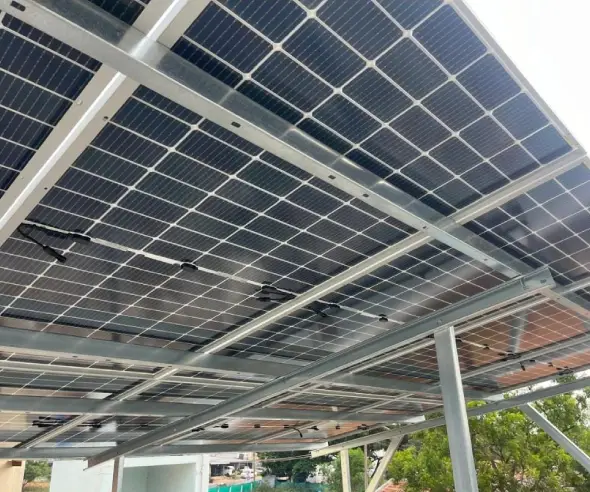
What Are Galvanized Steel Solar Mounting Structures?
Galvanized steel is widely used in solar mounting applications where high structural strength, wide support spans, and compatibility with varied foundation configurations are essential.
Key Advantages of Galvanized Steel Structures:
- High structural strength & stiffness: Steel offers superior load-bearing capacity and modulus of elasticity, making it ideal for high-wind regions, steep tilts, and long spans between supports.
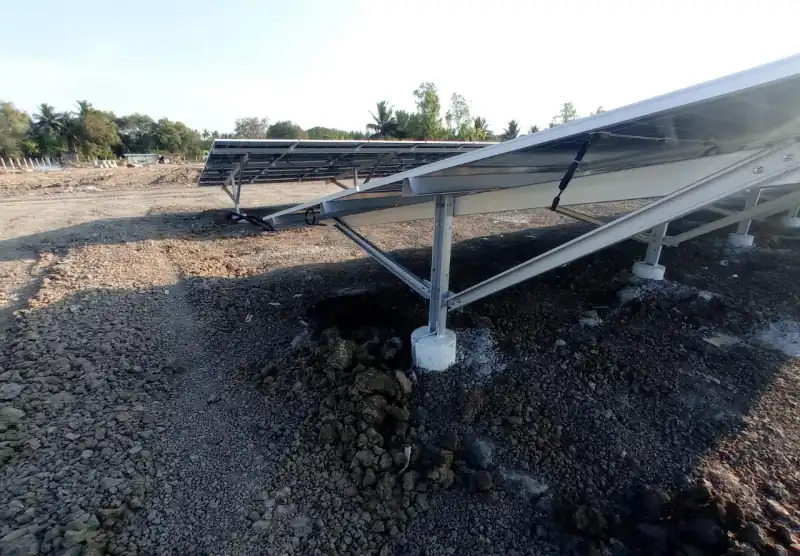
- Suitability for ground-mounted projects: Galvanized steel is the primary standard for utility-scale and ground-mount installations, accommodating driven piles, ground screws, and concrete foundations.
- Durable corrosion protection: Hot-dip galvanizing (conforming to IS 4759 / ISO 1461) provides both barrier shielding and cathodic sacrificial protection against atmospheric moisture.
- Versatile structural configurations: Readily roll-formed into standard C-channels, Z-purlins, Hat sections, and hollow structural sections (HSS) to match exact project engineering.
- Economical for large-scale utility solar: For projects requiring substantial tonnages of structural material, galvanized steel typically delivers a competitive cost per watt installed.
Limitations to Consider: Galvanized steel components are significantly heavier than aluminium, which increases rooftop dead load, transportation costs, and manual lifting effort on high roofs. In addition, cut edges, site-drilled holes, or damaged coatings require immediate zinc-rich paint touch-ups to prevent edge oxidation, particularly in humid or industrial zones.
What Are Aluminium Solar Mounting Structures?
The engineering suitability of aluminium depends on the specific structural alloy (commonly 6005-T5, 6063-T6, or 6082-T6), temper, extrusion geometry, and structural connection design.
Key Advantages of Aluminium Solar Structures:

Galvanized Steel vs Aluminium Solar Mounting Structures: Side-by-Side Comparison
| Comparison Factor | Galvanized Steel | Aluminium |
|---|---|---|
| Material weight | Generally heavier (approx. 7,850 kg/m³) | Generally lighter (approx. 2,700 kg/m³) |
| Structural characteristics | High strength and stiffness; easily handles long spans and high wind loads | Lower stiffness; performance depends on alloy, profile geometry, and wall thickness |
| Corrosion protection | Hot-dip zinc coating provides barrier and galvanic sacrificial protection | Naturally forming protective oxide film; commonly anodized for enhanced durability |
| Rooftop applications | Suitable when roof load capacity allows and structure is appropriately engineered | Commonly used and preferred for metal sheets, RCC terraces, and weight-sensitive roofs |
| Ground-mounted applications | Widely used industry benchmark across utility-scale and commercial projects | Possible in specialized terrain or utility setups, depending on structural economics |
| Fabrication method | Roll-formed C/Z sections, cold-formed channels, and fabricated weldments | Precision extruded profiles, slotted guide rails, and pre-assembled clamp components |
| Installation handling | Heavier components require more labor effort and potential lifting equipment | Lightweight components allow easy manual carrying and rapid modular assembly |
| Maintenance requirements | Periodic inspection of zinc coating condition, cut edges, and fastener torque | Minimal maintenance; check clamp tightness and electrical isolation gaskets |
| Initial material cost | Lower raw material cost per kg; economical for high tonnages and large MW plants | Higher raw material cost per kg; balanced by faster rooftop assembly and lower labor |
| Best selection criteria | Heavy structural loads, ground mounts, large spans, and scale-driven economics | Roof weight constraints, rooftop logistics, coastal atmospheres, and modular speed |
Important Engineering Takeaway
Neither material is automatically better for every solar project. The appropriate choice depends on the complete mounting system, regional wind speeds (conforming to IS 875 Part 3), roof loading constraints, environmental corrosivity, and overall project lifecycle economics.
Application-Specific Selection: Rooftop, Ground-Mount & Coastal Sites
Rooftop Solar Installations
For rooftop installations, material choice begins with the building’s structural reserve capacity and roof covering type:
When Galvanized Steel Is Preferred:
- Heavy elevated solar superstructures (e.g. raised pergola structures on RCC roofs).
- High wind-load regions where rigid steel sections resist uplift without excessive deflection.
- Roof can easily accommodate the system dead load and structural fixings.
When Aluminium Is Preferred:
- Pre-engineered building (PEB) metal roofs and trapezoidal / standing seam sheets.
- Projects where lightweight components speed up manual lifting and roof distribution.
- Modular click-in clamp systems that avoid roof puncturing or hot welding.
Ground-Mounted Solar Projects
Ground-mounted utility and captive plants demand high structural capacity across thousands of mounting tables:
Why Steel Dominates Ground Mounts:
- Versatile foundations: Easily driven directly into soil (ramming/piling) or anchored into concrete ballasts.
- High structural span: Supports large multi-row module tables (2P or 4L configurations) with minimal support posts.
- Superior economics: Significantly lower raw material cost per metric ton when procurement scales into megawatts.
Aluminium ground-mount setups exist for specialized soil conditions or rapid field bolting, but steel remains the dominant choice across Indian solar parks.
Solar Installations in Coastal Areas
Coastal environments expose mounting structures to continuous salt-laden marine air, severe humidity, and accelerated galvanic risks:
Critical Coastal Engineering Rules:
- Galvanized Steel: Demands higher zinc coating thickness (e.g. 80–120 µm or Zn-Al-Mg coatings) and rigorous edge sealing.
- Aluminium: Requires marine-grade alloys (6005-T5) with minimum 15–20 µm anodizing thickness to resist pitting.
- Fasteners & Isolation: Always specify SS304 / SS316 fasteners with EPDM isolating washers to prevent bi-metallic galvanic corrosion.
7 Critical Factors to Consider Before Selecting a Solar Mounting Structure
1. Project Location & Atmospheric Corrosivity
Wind velocity, rainfall, ambient humidity, industrial pollutants (sulphur/nitrogen oxides), and proximity to coastal shorelines determine whether standard galvanizing or heavy anodizing is required.
2. Roof Deck or Ground Foundation Conditions
Rooftop projects must verify structural load margins of purlins and trusses. Ground mounts require geotechnical soil testing to decide between rammed posts, helical screws, or RCC pad footings.
3. Wind-Load Requirements & IS 875 (Part 3) Compliance
Solar modules experience severe aerodynamic uplift and lateral shear forces during seasonal cyclones. All structures must be verified using 3D structural analysis software (such as STAAD Pro) per IS 875 (Part 3).
4. Corrosion Protection & Fastener Compatibility
Confirm base material metallurgical grades, zinc coating thickness in microns, anodizing layer depth, and hardware grade. Never mix bare steel screws with aluminium rails without isolating bushes.
5. Installation Handling & On-Site Logistics
Consider component weight, vertical hoisting onto multi-story industrial roofs, pre-punched hole patterns, and whether specialized cranes or simple manual tools are needed during assembly.
6. Total 25-Year Lifecycle Cost
Look beyond upfront purchase price per kilogram. Factor in structural freight costs, on-site labor hours, crane rentals, ongoing rust maintenance, and downtime risks over the full power purchase agreement (PPA) term.
7. Manufacturer Capabilities & Quality Assurance
Assess the supplier’s in-house engineering team, fabrication facilities, automated roll-forming and CNC cutting lines, ISO 9001:2015 certifications, and proven track record across Indian solar assets.
How to Choose a Reliable Solar Mounting Structure Manufacturer in India
A reliable manufacturer should understand both the structural engineering and on-site commercial realities of Indian solar installations. Before releasing a purchase order, audit prospective suppliers against these six benchmarks:
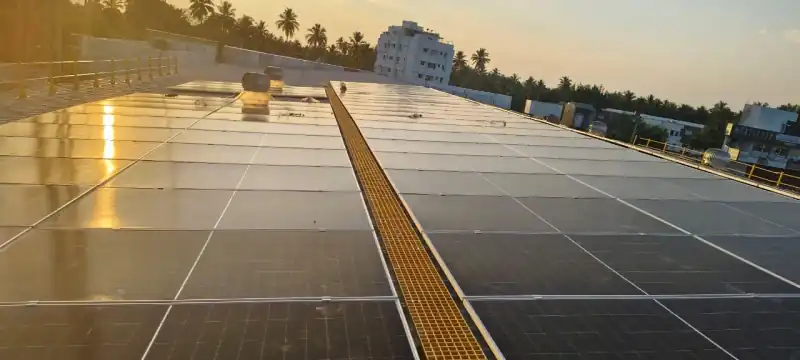
Why Consider VSL India for Solar Mounting Structures?
Venkateswara Suppliers Private Limited (operating as VSL India) is an ISO 9001:2015 certified manufacturer delivering engineered solar mounting structures alongside industrial FRP walkway gratings and handrails for industrial and infrastructure projects across India.
Whether your project demands heavy hot-dip galvanized steel ground tables or ultra-lightweight extruded aluminium rooftop rail assemblies, VSL India offers in-house structural analysis, precision manufacturing, and on-time project delivery.
📋 Requesting a Project Quotation?
Provide the following parameters to help our engineering team calculate precise sizing and provide competitive pricing:
- Project installation location & site coordinates
- Installation type: Rooftop (RCC/PEB metal sheet) or Ground Mount
- Required solar plant capacity (kWp/MWp) or module quantity
- Solar PV module dimensions, wattage, and frame thickness
- Available site layout drawings, roof pitch, and purlin spacing
- Environmental exposure (coastal, industrial, standard)
- Required delivery location and project commissioning schedule
Frequently Asked Questions (FAQ)
Is galvanized steel better than aluminium for solar mounting structures?
Not in every application. Galvanized steel offers high structural strength and stiffness, making it widely used in ground-mounted and large utility-scale systems. Aluminium offers significantly lower component weight and is commonly preferred in rooftop solar mounting systems. The right choice depends on structural design, environmental exposure, roof capacity, installation requirements, and total project cost.
Which material is lighter for solar mounting structures?
Aluminium is substantially less dense than steel—approximately one-third the weight of steel for an equal volume. However, the final weight of a complete mounting system depends on its profile dimensions, support spacing, connections, and structural engineering calculations.
Are aluminium solar mounting structures suitable for industrial rooftops?
Yes. Aluminium mounting systems are widely used and highly suitable for industrial rooftops, especially pre-engineered building (PEB) metal roofs and RCC slabs, provided the system is engineered for site-specific wind loads, purlin spacing, and solar module specifications.
Why is galvanizing important for steel solar structures?
Hot-dip galvanizing applies a metallurgical zinc coating that protects steel against corrosion through both physical shielding and cathodic sacrificial action. The required coating thickness (typically 80–120 microns depending on project specifications and IS 4759 standards) depends on regional atmospheric corrosivity and required project lifespan.
Which material requires less maintenance?
Aluminium generally requires less maintenance in typical atmospheric environments because its oxide layer naturally resists oxidation without regular recoating. Galvanized steel structures perform reliably for decades with adequate zinc thickness, but require periodic inspection of cut edges, drilled holes, and joints. Neither material is entirely maintenance-free in extreme or aggressive industrial environments.
What should I check before purchasing solar mounting structures?
Before placing an order, evaluate structural load calculations (including wind load compliance with IS 875 Part 3), base material grades, coating thickness or anodizing specification, module clamp compatibility, installation procedures, technical shop drawings, manufacturer quality-control certifications, and total installed lifecycle cost.
How can I request a quotation from VSL India?
Visit the official VSL India website (https://www.vslindia.com/) or contact the technical sales team directly. Provide your project location, installation type (rooftop or ground-mount), module capacity or module count, panel datasheets, roof or site layout drawings, and regional wind-load requirements to receive a customized technical proposal.
Conclusion: Making the Right Mounting Choice for Your Solar Plant
Galvanized steel and aluminium both play indispensable roles in modern solar infrastructure. Galvanized steel delivers high structural strength and unbeatable economics for large-scale ground mounts and heavy elevated frames, while aluminium provides lightweight, corrosion-resistant, modular ease for industrial and commercial rooftops.
For industrial facility owners, EPC contractors, and solar developers, comparing complete mounting systems against consistent technical specifications—including wind resilience, corrosion coating, and installation logistics—is the best way to secure a durable, cost-effective 25-year solar investment.
Discuss Your Solar Mounting Requirements With VSL India
Business Hours
Mon - Sat: 9:00 AM - 6:00 PM